Monday, 2 July 2018

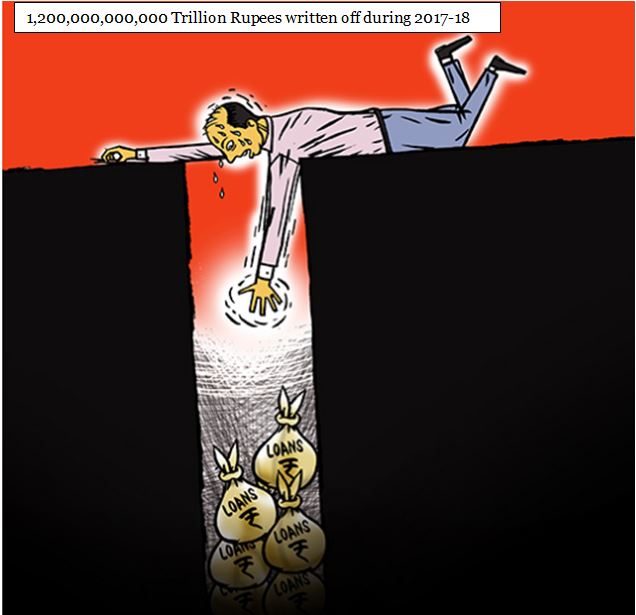
1,200,000,000,000 Trillion Rupees was written off by all PSU in 2017-18. Are we staring at a banking crisis??


Public sector banks accounted for over 85% of total frauds reported in the banking system in 2017-18, according to the RBI’s financial stability report (FSR). The banking system reported 6,500 frauds, amounting to more than ₹30,000 crore.

Yes, in 2018 we are getting to learn how poor the PSU banks are regulated, pathetic internal controls, poor IT infra, and least to say the this raises serious questions on how these banks are governaned?
The NPA mess is the biggest scam that the UPA Government has given in legacy to the NDA . 
Indian Banking sector, especially the state-owned banking segment, is under severe stress with mounting bad loans and an increase in bank fraud, among other issues. More than half of the listed state owned banks that account for about 20% of overall system advances are already under Prompt Corrective Action (PCA) framework, and a few more are expected join the list soon.
The non-performing assets (NPA) situation in the banking sector is alarming. At least 15.8% of the total loans in the banking sector are tagged under the stressed asset category. The nudge from RBI to clean up the system has shown the actual depth of the trouble on the books of Indian banks (hidden bad loans).
State-owned banks have already reported record level of bad loans resulting in huge cumulative losses of about Rs.55,000 crore in financial year (FY) 18 (reported thus far). Recent capital infusion of about Rs.88,000 crore was too little and too late.
The passage of the bankruptcy law was definitely a major step in the process of overhauling the banking sector. But the task is half-done yet. It needs to be well-supported by other comprehensive reforms in the sector such as adding more judicial muscle to NCLT; incentivizing faster resolution of NPAs through ARCs; reviewing ownership, control and governance issues of state-owned banks in the long run.
Bashing our banks, particularly the government-owned ones, which roughly have 70% market share of assets, has become a favourite pastime for many. Instead of going deep into the causes of deterioration in health and the possible remedies, let’s focus on some of the vital statistics to get a sense of the state of affairs in the ₹150 trillion banking system in the world’s fastest growing large economy.
Public sector banks (PSU banks) have written off non-performing assets (NPAs) worth Rs1.20 trillion, an amount that is nearly one-and-a-half times more than their total losses posted in 2017-18, according to official data. This is the first time in a decade that banks have made huge write-offs on bad loans while booking hefty losses.
A write-off means that the bank has made 100% provision from its earning against that account. This NPA is no longer part of the bank’s balance sheet.

The Table below gives the broader picture of the Gross and Net NPA of PSU and Pvt Banks. (Data taken from official RBI site) (Amount in Millions)
NATIONALISED BANKS
Gross NPA
Net NPAs
Bank
As on March 31 2017
Write-off during the Year
As on March 31 2018
As on March 31 2017
As on March 31 2018
STATE BANK OF INDIA & ITS ASSOCIATES
1219686
278388
1778106
688944
969322
ALLAHABAD BANK
153846
24421
206878
102925
134335
ANDHRA BANK
114436
16231
176700
60357
103548
BANK OF BARODA
405210
45156
427187
194065
180802
BANK OF INDIA
498791
72306
520445
279964
253050
BANK OF MAHARASHTRA
103859
13571
171887
69193
112296
BHARATIYA MAHILA BANK LTD.
14
-
550
7
462
CANARA BANK
316378
55448
342020
208329
216490
CENTRAL BANK OF INDIA
227210
23960
272510
132420
142180
CORPORATION BANK
145443
35737
170452
91601
116922
DENA BANK
85605
8334
126187
52305
77351
IDBI BANK LIMITED
248751
28682
447526
146434
252058
INDIAN BANK
88270
12254
98651
54194
56066
INDIAN OVERSEAS BANK
300486
29540
350983
192126
197493
ORIENTAL BANK OF COMMERCE
147018
23083
228593
99322
141178
PUNJAB AND SIND BANK
42291
4906
62976
29495
43751
PUNJAB NATIONAL BANK
558183
92051
553705
354226
327021
SYNDICATE BANK
138322
12707
176093
90149
104110
UCO BANK
209077
19339
225410
114436
107034
UNION BANK OF INDIA
241709
12637
337123
140259
188321
UNITED BANK OF INDIA
94710
7137
109520
61107
65919
VIJAYA BANK
60271
10683
63818
42768
41182
NATIONALISED BANKS
4179879
548183
5069213
2515681
2861567


PRIVATE SECTOR BANKS
Gross NPA
Net NPAs
Bank
As on March 31 2017
Write-off during the Year
As on March 31 2018
As on March 31 2017
As on March 31 2018
AXIS BANK LIMITED
60875
22221
212805
25221
86266
BANDHAN BANK LIMITED
188
312
863
102
612
CATHOLIC SYRIAN BANK LTD
4469
1393
6001
3452
4476
CITY UNION BANK LIMITED
5120
1635
6820
3232
4083
DCB BANK LIMITED
1974
444
2542
975
1244
FEDERAL BANK LTD
16678
2364
17271
9500
9412
HDFC BANK LTD.
43928
23859
58857
13204
18440
ICICI BANK LIMITED
262213
121919
421594
129631
252168
IDFC BANK LIMITED
30583
0
15421
11390
5765
INDUSIND BANK LTD
7768
4655
10549
3218
4389
JAMMU & KASHMIR BANK LTD
43686
8570
60000
21640
24254
KARNATAKA BANK LTD
11804
4580
15816
7955
9747
KARUR VYSYA BANK LTD
5112
2638
14838
2162
10335
KOTAK MAHINDRA BANK LTD.
28381
4223
35786
12620
17181
LAKSHMI VILAS BANK LTD
3913
915
6402
2316
4184
NAINITAL BANK LTD
1210
6
1643
277
395
RBL BANK LIMITED
2081
687
3568
1244
1899
SOUTH INDIAN BANK LTD
15624
738
11490
11853
6746
TAMILNAD MERCANTILE BANK LTD
4189
2438
6486
2007
3819
THE DHANALAKSHMI BANK LTD
4589
1890
3156
1932
1665
YES BANK LTD.
7490
1421
20186
2845
10723
PRIVATE SECTOR BANKS
561874
206907
932092
266774
477802

Till 1969, the State Bank of India (SBI) was the only bank that was not privately owned. It was called the Imperial Bank before its nationalisation in 1955. There were primarily two reasons why the ownership of these 14 banks was transferred to the government. The first was the unpredictable manner in which these functioned as private entities.As this report in The Economic Times points out, there were 361 private banks which "failed" across the country in the period from 1947 to 1955, translating to an average of over 40 banks per year. More often than not, this resulted in depositors losing all their money as they were not offered any guarantee by their respective banks.
Second, these commercial banks were seen as catering to the large industries and businesses. Agriculture, as a sector, was largely ignored by these banks
So What Benefits Did Bank Nationalisation Promise? In 1969 only depositors lost money in 2018 tax payers money is literally flushed down the drain by these so called Nationalised bank.
In light of these circumstances, the stated motive of this measure was to make credit availability easy for what was called the “priority sector” – constituting agriculture, small industries, traders and entrepreneurs. Moreover, the focus was also on opening up of bank branches in the rural and backward areas.
Even as frauds and murky dealings continue to tumble out of the closets of the biggest names in Indian banking, there is danger in assuming that the problem is restricted to that industry.
India’s banking crisis isn’t just about the likes of Punjab National Bank, Bank of Maharashtra or ICICI Bank Ltd. India’s corporate sector, including some of its largest companies, is as much a part of the toxic environment that is now unravelling before us.
There are scores of reasons for the appalling performance of the banks some of the prime reasons  are
Political appointments; Majority  of the CMD, Directors in the PSU were all political appointee who would open the bank treasure on one phone call from the south block!  How can a scam of Nirav Modi go untraced for 4-5 years when there are 3-4 types of audits which happen every year? Definitely one rouge manager in some branch of Mumbai cannot pull off the scam of a millennium!
Corrupt Finance Minister; P Chidambaram who now is running from one court to other seeking bail for himself and his family members the moment he completes taking pot shots at the Modi govt. This guy is was cheap and corrupt that he ordered Canara Bank to change its logo and sign board and in turn he made a cut off the total amount spent on money spent on doing the overhauling the signboard etc. One can gage how the finance of the country were handled during UPA 1&2
Every Indian company, large and small, has at some stage put pressure on bankers to bend the rules either for sanctioning loans or changing the repayment terms. Even as we rail against the executives and the boards of the banks for conniving with borrowers, let’s not forget who they were conniving with and for what.
Whether it is Rotomac or Nirav Modi, the script remains unchanged. Banks have always been a fertile ground for political and corporate patronage.There’s nothing new about this. For decades, money in the banks has been treated as the personal fiefdom of a few.
In the 1980s, there were the notorious loan melas, where politicians doled out funds through nationalized banks without bothering about basic hygiene factors. Often, even the loan application forms would be filled by bank staffers.
Post 1991, with the onset of private banking, it was expected that more care and caution would be exercised. But as the Indian economy moved into high gear following a global surge in growth, Indian companies suddenly acquired a voracious appetite for bank loans to fuel their many ill-conceived investments.
Significantly, once the easy-money regime changed, particularly after Raghuram Rajan turned the central bank’s lens on the lending and provisioning practices of the banks, Indian companies’ appetite for investments also dried up.
It is one thing to plan ambitious projects or large acquisitions with the reassuring backing of soft loans at nominal rates of interest and flexible repayment terms and quite another to do so on more stringent forms of financing.
The returns needed to service a bank loan are different from those needed to service any other form of financing. 
Not surprisingly, after 2010, there has been a decline in the share of gross capital formation (GCF) in GDP, from 38.2% to 32.3% between 2011–2012 and 2013–2014, with the corporate sector’s contribution as GCF also
If banks have failed to judge the creditworthiness of the companies they have lent to or failed to detect those initial signs of stress before a loan turns non-performing, it is in part because of the elaborate efforts companies make to window dress their accounts.
When the chairman of Syndicate Bank is arrested for taking a bribe from the promoters of Bhushan Steel, both are equally culpable and deserve opprobrium.
But when Bhushan Steel becomes the norm for corporate behaviour and a symbol of the manipulative power of our largest companies, it is time to worry.
By cornering an abnormal share of bank loans, large Indian companies have also created a canopy for themselves, one under which more deserving and needy smaller businesses fail to grow for want of credit.
Bad loans at Indian banks, especially those controlled by the government, will increase further in the year to 31 March, placing additional strain on the already stressed financial system, a central bank study warned.
Gross non-performing asset (NPA) ratio of banks will rise to 12.2% by March 2019 from 11.6% at the end of the previous fiscal if economic conditions remain the same, said the Reserve Bank of India (RBI) financial stability report.
The report said weak profitability of banks is an additional concern as it prevents lenders from setting aside adequate money to cover potential losses on loans and makes them vulnerable to adverse shocks. 
In a scenario of severe stress, this ratio may rise to as high as 13.3% by March, the report said. For public sector banks, this ratio may jump to 17.3% by March.
Rising bad loans will also lead to further erosion of capital buffers. The capital adequacy ratio of banks will drop to 12.8% by March 2019 from 13.5% at the end of the previous year. A severe shock could, however, bring down the capital adequacy ratio of as many as 20 banks, mostly state-run, below 9%, the report said.
Analysing the effectiveness of prompt corrective action (PCA), the stability report said the gross NPA ratio of state-run banks under PCA will worsen to 22.3% by March, with six banks likely to experience capital shortfall under the baseline scenario.
Modi Govt has a herculean task to tackle the NPA mess on one hand, fund the credit demand, and manage the fiscal deficit without increasing market borrowing. Raising taxes would make him unpopular in the election year. With the global economy going through a slugging phase with rising trade wars between US and China, Its India which is suffering as a collateral.
If NaMo manages to pull off this banking mess and sets it in order, he would have laid the foundation for a strong economic growth in the coming decade!   

Friday, 1 June 2018

Hits and misses of Modi Govt. Series 1

Hits and misses of Modi Govt. Series 1

As we head into the elections of several states and general elections in 2019, we will virtually be in a state/mood of elections starting this October and if rumors are to believed general elections of 2019 could be called in early to co-inside with the state elections. Which, normally be beneficial to the Govt. at center as they would have higher chances of winning and also save time, money and resources. Many would be wondering what has the Modi Govt. done in the last 4 years after getting a thumping victory in 2014, its achievements, failures, work in progress and missed opportunities. Today, I would like to start a series of articles on performance of NDA, first starting with the state of economy, and with special focus on middle and lower income class of people.
The masses in India which mostly constitute the middle, lower middle class and people who earn less than $5 who we can below poverty line population. These are the people who are not very impressed or can be enticed by the sexy GDP numbers, fancy graphs, FDI, Foreign reserves, or for that matter who own flipkart post it being acquired by Walmart. All the matter to them is the feel good factor i.e. cheaper fuel, food (includes vegetables, fruits, milk etc.), quality of education, inflation, interest rates, roads, etc. mostly tangible things which we are greatly dependent on day to day basis and on which majority of budget focuses on. So let’s dive in and analyze what were the hits and misses for the middle class.
1.       Let me first start with income tax slabs. FM Arun Jatley did a decent job as compared to his previous FM in adding to the savings by the middle classes. Income exempt from income tax has been raised to 2.5 lakh i.e. anyone earning up to 2.5 L per annum is exempt from any kind of income tax, which is 50,000 more exempted compared to 2013-14 where it was just 2 lakh. So the Modi Govt. gave a straight away exemption of 50k in the very first year itself. Hence, people who are earning salary in the range of 2-3 lakh per annum made some decent savings of 2 lakhs in 4 years.  People earning up to 5-10 lakh per annum. The rates in 2013-14 were 10% for incomes up to 5 lakh and now in FY 2018-19 it’s now 5% so there is another decent saving here as well. There have been no major changes in the 10 lakh and above slabs. So here we can say it’s a decent job.
2.       Inflation: This is where the Modi Govt. has done good job. Keeping he inflation below 5%, food inflation which was a major cause of concern for the country is been kept in check with decent amount of pulses, sugar etc. being imported at the right time and now most of the pulses cost less than 70 RS, Sugar less than 50 RS. Respectively (these are the retail prices, and sold in lose quantity, not considered the branded or package food).
With the introduction of Aadhar linked rationing of food to the poor and lower middle class, has eliminated many fictional beneficiaries, and miss appropriation of funds and the same subsidized food being sold in black. This is a major success of the Modi Govt.
3.       Fuel: This is going to be a very a controversial and touchy topic as people are directly impacted by every single paisa increase in the cost of fuel prices. Here, the audience would judge the Govt. based on how they see the overall performance vs just the fuel prices. If are wholly concentrating on how the price of fuel have risen from 71 RS in June 2014 to 56 RS being the least and now back to 75 RS. There are scores of people who get affected by fuel prices and may forget all the good the govt. has done and come blasting the moment there is a single paisa increase, quite natural to expect from them.
However, looking at the larger picture the taxes collected on the fuel has been used wisely used in these 4 years , from recapitalization of PSU banks, building high quality Highways, State Discoms refinancing (most of them where literally bankrupt) Railways, various social schemes like Ujwala, PMAY etc. which have reached the last mile beneficiary. Hence, I leave this to the people to judge based on how they feel.
4.       Economic policies for the poor and masses: This is one area where I think the Govt. has passed with distinction, starting from Ujwala Yojna, PMAY, Crop insurance, Insurance for the poor masses at 1 Rs per day and 300 annually, Toilets, sanitary pads available at subsidized rates, opening 50 lakh Jan-dhan saving account, Sukanya Samrudhi Yojan, Beti padhao-Beti bachao, Atal Pension Yojna , PM vridha pension vojna etc these are great steps taken by the Govt. to provide social security to the masses who were often left venerable in old age. Mudhra Yojna this is single biggest feather in the cap of Modi Govt. This scheme is the single biggest booster/financial support to encourage small and medium enterprise in big way. I have seen many people from UP, Bihar coming to Bangalore to open chat shops with loans taken in Mudra and repaying the entire loan in a period of 10 months and being self-sufficient, these may not catch attention of the people who crib about the high fuel price but they should take pride that there monies are being utilized and given to the deserving people.
5.       Interest Rates: While buying and owning homes is a biggest dream for a middle class family who save money for years so that they can afford to buy/build a small home for themselves before they retire. In 2014 when the Modi Govt. took over the home loan interest rates were hovering at 12% which was very expensive, driving away builders to build small and affordable homes, people who already availed loans were in a very tight spot killing most of their savings. Thanks to the Modi. Govt effective handling of inflation the interest rates have fallen to 5% and the interest rates brought down to 8% which is  saving of 4% straight in 4 years! This is saving of 2k to14k (depending on loan amount) which is huge! The savings made in one EMI is in fact more than the increment in fuel price! And with the introduction of PMAY it has proved to be a boon for the people who live in small cities, they get a subsidy of 2% on the interest! This comes as additional saving to the above!
6.       Demonetization: Yet another controversial policy decision. While I analyze the benefits and losses of this policy one biggest benefit of this policy is it has made many people who do not even know E of Economics turn into economist and SMEs overnight, all of them giving fancy numbers of benefits to bad news of people losing jobs, loss to GDP etc. It was a very comic to see some of the journalist coming every day out of the studios and trying to instigate people to speak something against the Modi Govt. and they can use that to cane the Govt. but were surprised to learn that people were in convinced but were cooperating! Stood in long liens but did not riot on the roads! Remember in Venezuela there were riots and the Govt. had to recall the decision of demon. Within 48 hours!
Let’s analyze the success or failure of the policy; there are scores of people who held unaccounted cash who were surely panicking, and were begging there domestic helps, drivers etc. to get the cash converted for them, this was a first time that the poor actually felt that the rich (who gained wealth illegally) are suffering and poor though are not benefiting directly are happy to see them suffer. Post demon, most of the cash is claimed to be brought back into the banking system which has improved the liquidity, and got the address of the people who owned these monies till now. Higher direct tax payers, new tax payers have been growing steadily since then which is a good sign, however insufficient. All the informal business was now brought under the formal economy, increase in digital payment system which would reduce the use of cash. Etc. there are many benefits of this policy. Where it failed is rich and crooks got away by bribing the bankers by paying them a good commission on converting the old notes to new one, so the controls were clearly missing, ATM were not put in place to dispense new notes, scores of daily wagers where unemployed form some days, some even going back to home towns, GDP did take a hit in Q2-Q3 of 2017. But in the long term the Govt. coming in future are going to benefit immensely by concentrating on driving digitization, reducing the cash economy and eventually tackling black economy or tax evasion. If you see the poor, middle class, had nothing to lose here since they hardly have anything to hide, since everything is earned and spent in white. The only people who are cribbing and complaining are the ones who are now forced to explain these income sources. Hence I would ignore all those doomsday predictions written in newspapers by the ex-FM, so called journalist etc. is all rubbish and humbug.
7.       GST: This is clearly a work in progress, where the GST council is meeting every month to discuss the rates, procedures, way bills etc. This is surly the biggest and largest indirect tax reform done by any Govt. in independent India. While there are scores of teething issues in the beginning, it has more or less eased; people are not getting used to the system and will eventually stop complaining and comply fully in paying taxes honestly. In the month of April the Govt has already collected 1 lakh crore of GST which is quite an achievement considering its implementation issues.    
These were the major economic policies where taken by Modi Govt and influenced the masses. In the next series, I will continue to discuss various hits and misses of this govt.  
Thanks for patient reading, please feel free to give your suggestions and feedback.


Sunday, 12 February 2017

Eye for an Eye. PM Modi gives it back to obstructionist Congress!


Honestly, it is rank hypocrisy to try and stall Parliament over the Prime Minister’s rather clever response to his predecessor for his downright provocative description of demonetisation as “organised loot and legalised plunder”. What had possessed the usually meek and soft-spoken Manmohan Singh we cannot tell, he was not known to speak in such offensively hyperbolic terms. Those remarks were particularly odious. Not even the worst critics of notebandi had called it an “organised loot and legalised plunder”.

It was certainly badly executed, but there was no doubting either the laudable objective behind the scrapping of big notes, nor the gains that are eventually set to flow from it. To tell the truth, the real guilty are those who had allowed the money supply to more than double from six to over twelve per cent of the GDP under their watch. In fact, Modi most courageously undertook to reduce the excessive cash sloshing around in the economy. Modern economies have four to five per cent money in circulation. If the US and Japan have more, it is due to entirely different reasons, the former because it is a global currency and the latter because the old and ageing Japanese tend to keep a lot of cash handy.

Indeed, one likely reason for excessive cash in the economy might be the open “loot and plunder” of the public sector banks during the UPA decade, something P. Chidambaram ought to realise, when he now feigns surprise at the rising NPAs. If the bad debts of banks are now mounting, it is not because the Modi ministers are nudging the banks to lend to all comers, as was the case under the previous regime. It is because Modi has stopped evergreening of the old and failed loans, a practice so prevalent under UPA that hundreds of crores were given to Vijay Mallya, in spite of resistance by various banks.

We have digressed. To get back to Modi saying that only Manmohan Singh “knows the art of taking bath in the bathroom while wearing a raincoat, no one else does” there are two straightforward ways to quell the howls of protest from the Congress. One, by dwelling on what the PM most probably meant. Simply put, that in spite of presiding over one of the most corrupt governments in free India, in spite of himself handling the coal ministry when the coal scam happened, Singh continues to bask in his lily-white innocence.

The veteran opportunist—he was rooting for controls and restrictions on economic growth literally a few days before Narasimha Rao made him Finance Minister—who saw the Harshad Mehta and Ketan Parekh scams under his direct watch, continues to believe that his own financial integrity is reason enough for him to go unscathed. Frankly, he is not the only clean politician around. Why, even the Congress had honest leaders such as Gulzari Lal Nanda, U.N. Dhevar, Lal Bahadur Shashtri, to name but only the three that come to mind. Of course, the non-Congress bloc boasts of a large contingent, from L.K. Advani, Nitish Kumar, M.M. Joshi, to a host of others. Moreover, none of them had personally glossed over corruption so that they could be allowed to retain their senior ministerial posts. Why, then, should anyone make special allowance for someone who though financially clean was responsible for running a corrupt finance ministry and, later, prime ministry?l

The other way to respond to the Congress criticism of Modi’s raincoat remark is, of course, to hold the mirror to the loudmouths. Rajiv Gandhi had publicly dismissed Manmohan Singh and his fellow members of the Planning Commission as “a bunch of jokers”. Rajiv Gandhi’s promising son, Rahul, in fact, had gone a step further in showing respect, as multi-faced Chidambaram demanded in the Rajya Sabha last Thursday, 9 February, for the office of the Prime Minister of India. The ordinance issued by the Singh government, the Congress heir had called “nonsense”, while dramatically tearing it up at a news conference. Was, according to Chidambaram, Rahul being dignified and respectful towards the PM, a PM who belonged to the party virtually owned by him?

The larger point, of course, is the generally low-level of public discourse. The Vajpayees and Hiren Mukherjees, Ambedkar, Mahajan etc alas, are no longer around. Now parliamentarians on both sides of the aisle no longer debate policies, programmes, ideology et al. It is unremitting mud-slinging and distasteful tu, tu, mein, mein both inside and outside legislatures. Now with The advent of Arvind Kejriwal has only further sullied the atmosphere. Easily, the most obnoxious politician around, he sleepwalks through the day and night hurling abuses at all and sundry, including the Election Commission—virtually, anyone whom he might suspect of thwarting his prime ministerial ambitions.

Let's end the blog on a sarcastic note.

The late Feroze Gandhi was known for his ready repartee and saucy sarcasm. Prior to the elections in Bihar in the late 1950s, there were reports of how Morarji Desai, a Gandhian to the core and the Congress “observer” had made it clear that party nominees had to only don khadi. Such was the extent of his zeal that to ensure that it was khadi all the way, he would insist on the nominees he interviewed to even show him their vests under their kurta to ascertain if that that too was made of the same material. Feroze, who had a rather bland opinion about Morarji, called out to his friend Tarakeshwari Sinha, then an upcoming politician from the state and politely asked her in the presence of many others in the Central Hall whether Morarji was similarly examining the petticoats of women to confirm their khadi fabric. Veterans till this day have a hearty laugh while recalling what came to be known as the “baniyan petticoat joke in the Central Hall”.

Monday, 30 January 2017

Why is freedom of artistic expression always at the expense of Hindu sensibilities

After Bajirao Mastani, director Sanjay Leela Bhansali is making another period drama film, Padmavati, this time about Rani Padmini, the queen of Chittorgarh, and Alauddin Khilji, the ruler of Delhi. According to media reports, the film will feature a love story between Padmini and Khilji.            
On Friday afternoon, members of the Rajput Karni Sena assaulted Sanjay Leela Bhansali. The attack occurred on the sets of Bhansali’s period drama Padmavati in Jaipur’s Jaigarh Fort. Scores of Rajput Karni Sena protestors breached the private security of the set before proceeding to assault the director and vandalise the film’s set. As usual the entire Bollywood fraternity, Several “liberal” columnists have expressed anguish at this Their defence of the film-maker and demonization of the protestors involves the following ‘liberal’ arguments such as;

1. Cinema is a form of creative expression and artistic license permits historical reinterpretation, even if devoid of historical merit.
2. What about freedom of expression? If you don’t like the movie, do not watch it, or just make your own movie on the subject.


Here lies the hypocrisy and double standards of  Bollywood  and  the liberals, see how Shabana Azmi exposes herself , here she strongly defends SLB and calls the mobs as goonda etc. I agree with her here. But she immediately changes her defence and stand when it comes to AR Rehman; He was supposed to compose the music for the movie "Muhammad: The Messenger of God" and then a fatwa was issued post which he had to succumb to this pressure and give in. In this case the goondaism and open threat to  AR Rehman  from these Mullhas is completely fine because “that is inflammatory and would hurt sentiments of Muslim community”.
The analysis of each of these positions reveals the problematic nature of contemporary Indian “secular-liberal” discourse, its bias, duplicity, mendacity and lack of sensitivity, while exploring Hindu culture, history and traditions. Every Islamic tyrant, fanatic and mass murderer from Khilji to Tipu to Aurangzeb is being glorified under d label of 'artistic rebelling' but my question here is, Why is freedom of artistic expression always at the expense of Hindu sensibilities? If SLB or any other director in Bollywood makes anti-Muslim films he would have been dead by now and not just thrashed.

The history about Padmini is far more complex than the rude and vulgar “secular” fictionalization of a legendary figure whose sacred memory is alive in the hearts and minds of millions of Hindus. In the land of Chittor, century old temples and shrines dedicated to the memory of the legendary princess continue to be active sites of devotion. Therefore, there is clearly an element of traditional religiosity in the Padmavati saga, which has over time acquired a graceful sanctity.  Any attempt, to apparently violate the sacred memory of Padmavati built through centuries of cultural memory and oral tradition through a reckless act of commercial Bollywood cinema could be interpreted as an act of perversion, at least by those who believe and identify with her.

The same “secularists” who demand historical evidence enthusiastically while considering respect for tradition fulminate against the idea of historical evidence documenting large scale pogroms, genocides, forced conversions and temple destructions during the medieval age by Islamist invaders.

Nevertheless, purely from a historical perspective, it is true that there is no contemporary account, which corroborates the legend of Padmini, the beautiful Rajput princess who along with thousands of other women defied the will of the Muslim ruler, Alauddin Khilji through the act of Jauhar (mass immolation) and frustrated his designs of possessing her. This significant omission was observed by the preeminent historian of medieval India.

Anyway this is an opportune time to re-visit our history and set the perspective right about our history and rich heritage. Let me walk you through the history of  Khilji.

Alauddin Khilji the Sultan ascended the throne by murdering the emperor Jalauddin Khilji. His expeditions against Hindu kingdoms resulted in at least three instances of Jauhar or mass immolation by thousands of Hindu women in order to protect their honour both in life and death. At Chittor, Amir Khusrau found the emperor to ‘have cut the Hindus like dry grass’ by ordering a general massacre of the population, a feat, which was replicated by the great Mughal emperor Akbar almost two centuries later.  During his tyrannical rule, Alauddin was barbaric as other Muglas was also very ambitious. He expanded his kingdom across India and during this expansion he attacked on Chittor in 1303 CE to capture the queen of Chittor, Rani Padmini, the wife of Rawal Ratan Singh and the subsequent story have been immortalized in the epic poem Padmavat, written by Malik Muhammad Jayasi

Jayasi wrote this poem almost 237 years after Khilji's attack on Chittor. The literature of that era is full of highly imaginative narratives, and poets were known to gleefully use metaphors, alliterations and imaginary personifications. There is also a reference in Padmavat to a sorcerer called Raghav Chetan, who is believed to have been personified as a parrot.
According to Jayasi’s poem Rani Padmavati of Chittor was the wife of Raja Ratansen (a name invented by Jayasi with no reference in Mewar history) of Chittor during the reign of Allauddin Khilji. The correct name of Chittor's then ruler was Rawal Ratan Singh, the thirty-fourth descendant of Bappa Rawal.

What Jayasi’s poem says.

There were many talented artists in the court of Ratansen, one of whom was a musician named Raghava Chetan. He was a sorcerer who used his magical powers to target rivals. Once, he was caught red-handed while trying to invoke evil spirits, after which Ratansen banished Raghava from the kingdom after blackening his face. Raghava ran away to Delhi and decided to take revenge by provoking Khilji to attack Chittor.

Raghava knew of a forest near Delhi where Khilji went hunting. One day, he played his flute while Khilji was out hunting. The alluring notes emanating from his flute attracted the attention of Khilji, who then asked his soldiers to fetch the flute player. Thus, Raghava was taken to Khilji's court.

After reaching Delhi, Raghava told Khilji about the unparalleled beauty of Rani Padmini. That prompted Khilji to attack Chittor, ( quite a lust full character ) but he found the fort to be heavily defended. So he laid siege to the fort and forced Ratansen to negotiate with him.

Desperate to capture the beautiful Padmini, Khilji sent a word to Ratansen about him wanting to meet her. The Raja asked Padmini, who flatly refused. However, on being persuaded by her beleaguered husband, Rani Padmini agreed to let Khilji see her in the mirror.

The sex maniac that he was could not control his lust and cunningly went ahead and ordered his army to storm Chittorgarh. However, the army could not break into the fort. Due to a prolonged siege, food supplies for the troops were running out. So Ratansen opened the fort gates, and Rajputs rode out to fight. They were overpowered, and achieved martyrdom. Rani Padmini and wives of thousands of warriors preferred jauhar (fire is lit, and women jump into the flames) over losing their honour to Khilji's army. When Khilji entered the fort, all that he found were ashes of these brave women.

Credits: India Facts.com, Swarajya Magazine,Wikipedia.  

Friday, 27 January 2017

Nero Fiddled While Rome Burned

I will come to the real story once we read a little history. Nero was Roman Emperor from 54 to 68 AD, and the last in the Julio-Claudian dynasty. The source of this phrase is the story that Nero played the fiddle (violin) while Rome burned, during the great fire in AD 64.
In 64 AD, most of Rome was destroyed in the Great Fire of Rome. Suetonius,(Ram Ghua or Rana Ayyub  of those days) writing a generation later claims that many Romans believed Nero himself had started the fire, in order to clear land for his planned palatial complex, the Domus Aurea. In 68, the rebellion of Vindex in Gaul and later the acclamation of Galba in Hispania drove Nero from the throne. Facing a false report of being denounced as a public enemy who was to be executed, he committed suicide on 9 June 68 (the first Roman emperor to do so). His death ended the Julio-Claudian dynasty, sparking a brief period of civil wars known as the Year of the Four Emperors. Nero's rule is often associated with tyranny and extravagance. He is known for many executions, including that of his mother, and the probable murder by poison of his stepbrother Britannicus. Nero was rumoured to have had captured Christians dipped in oil and set on fire in his garden at night as a source of light. By modern-day standards Nero certainly appears a bizarre character, but that doesn't make this story true. Roman scholars differ over interpretations of events surrounding the fire.

Coming to the present day, the above story is very relevant because this is the kind of filth most of the media in India spreads. Today I will expose the hypocrisy of this so called Liberal and main stream media journalist Shekhar Gupta.
In the back drop of the recent incidents that happened in Chennai on Jallikattu. When the police wanted to the protesting crowd to clear site and went on to evacuate forcefully. This action by police led to serious law and order situation where bus, shops etc. were burnt during the unfortunate incident. Read this tweet by him.


This thug who cunningly tries to instigate the Muslims and law and order situation with this kind of instigating tweet where he compares the action of police with the stone palters of Kashmir. He finds the people of Chennai as so called freedom fighters or demanding Azadi from India. Mr. Gupta let them do it for 20 years. Pellet guns will appear in Chennai too. Here lies his hypocrisy in the tweet above he mentions “Tough question, but needs to be asked: a police station/vehicles are burnt in the heart of Chennai” this provokes me to ask him; Mr Gupta where were your tough questions when very recently The anti-Hindu riots in Deganga to the recent Dhulagarh one have been quietly covered up by the MSM. Not just cover up but the media-mafia even certifies these are just rumours being spread on Twitter as the street-thug consistently informs on anti-Hindu riots, here is another liar Rajdeep who goes on to the extent of certifying it as a rumour.


Fortunately, individuals still stand out and investigate and bring us the truth of the anti-Hindu violence in Bengal. These communal riots are not even “incidents” anymore. They are well-organised cleansing of Hindus from Muslim towns or areas with a clear plan of another exodus like the Kashmir one. Coming to the main topic forget about the tough questions by Mr. Gupta this is what he tweets.


Tough questions indeed!! Mr Gupta?? This is here were I compare Mr. Gupta to the story of Nero. When the Hindus were being killed, raped and looted in broad day light by the goons of the “Trinamullah Goons” lead by the jigadi CM. (I don’t see any difference between the culture of the murderous ISIS and the goons of Trinamullah Congress or the CPM or CPI in India) He wines and dines with the criminals and corrupt and when there is a genuine uprising against the illogical ban in Hindu festivals and traditions by SC he wants Pellet guns.

Let me expose his another lie, where he famously earned a title “Coupe Gupta”  the story goes as
April 4, the Indian Express splashes a front page story with screaming headlines: “The January night Raisina Hill was spooked: Two key Army units moved towards Delhi without notifying Govt.” This is about the night of January 16 when the Army chief and the govt. were in a confrontation over the General’s age issue.
On January 16 the army chief had filed a petition in the Supreme Court in the issue of his date of birth. But the mischief is not in the event or the incident of January 16 itself. The mischief is in the headline of IE, especially when read in the background of recent bad-blood between the Army and the Defence Ministry and the govt. It clearly led all other news outlets and the general public to believe that there was a possible ‘coup’ attempt that night.
Given that the Army chief has had confrontations with the defence ministry, there is a stinging letter by him to the PM which was leaked (and exposed by DNA), and this has resulted in the govt. cutting a sorry figure in the continuing episodes, something had to be done. That seems to be the motive behind the sensational headline by Shekhar Gupta which makes it sound as if the Army had nearly run over an elected govt. in India. Secondly, the article also clandestinely casts a shadow over Gen. VK Singh and makes it sound like he may have gone to the extent of over-throwing the govt. on account of his fight with the govt. Of course, it doesn’t say all this in so many words but let’s you draw that conclusion.

Once upon a time the IE was the second most read newspaper in Bombay and in many other cities. It has sunk without a trace in many cities and survival against competition can only be with putting out lousy stories with screaming headlines. By evening today, Shekhar Gupta is the laughing stock of the nation.


Sunday, 14 August 2016

Kick Geelani Out; Save Kashmir


                                        To save Kashmir, kick out Geelani

Let’s start first by admitting that from the start BJP joining hands with the PDP to form a government in Jammu & Kashmir is a big blunder. Just for the sake of securing a few puny ministerships, had the party opted to be in the opposition and allowed a combination of the PDP, the National Conference and the Congress party to take over in Srinagar, very soon public opinion would have turned against such an alliance, and in the mid-term elections that would almost certainly follow, the BJP may have secured just enough seats in Kashmir to come to power on its own. With every year that passes, the attractiveness of Pakistan as an alternative to Indian statehood is getting reduced, so much so that apart from Syed Ali Shah Geelani and a few others loyal to the salt which nourishes them, most of those whose occupation it is to protest against the rest of India, work on the basis the desirable option is a level of autonomy sufficient to ensure total Wahhabisation. Such individuals are not satisfied with the partial Wahhabisation that has been implemented in Jammu & Kashmir since the Congress party allowed Sheikh Abdullah in 1947 to take over as Prime Minister, later on being turfed out, but thereafter displacing secular predecessors, who, had they continued, would have ensured the extinguishing of the unreal hope that the state could, through unrest or rebellion, win an overwhelmingly Wahhabised governance structure that would be independent of the Central government in every particular barring the formal.
Unfortunately for the people of the state and for the rest of the country, the 15% or so of the population that are partial or total Wahhabis is the only segment taken into account by both the media as well as the Central government. (fell extremely sad and outraged at the Modi Govt. for excluding the kashmiri Pandits who too are a party and rightfull owners of the valley) Of course, such a disastrous concession to a fundamentally undemocratic group has since been justified on the grounds first of “secularism” and now on the grounds of “pragmatism”. The BJP argues that its presence in the state government ensures that the state “does not slip into anarchy”. The Ministry of Home Affairs, which is historically known for neglecting societal sores until they turn cancerous, apparently believes that the presence of a BJP Deputy Chief Minister and miscellaneous ministers from the party is sufficient to ensure that Srinagar keep to the path of fealty to the Constitution of India. The MHA has, therefore, outsourced to J&K BJP ministers its job of ensuring adherence within the ruling structure of Kashmir to the political and governance principles ensuring the unity of this country. This despite the fact that from the start, these necessary principles have been ignored by the Wahhabis and their backers within the inner recesses of the governance mechanism of the state. Despite having only a slightly higher number of seats than the BJP, the PDP has arrogated to itself about 90% of the effective powers of the state government, of course in the name of “secularism” and “pragmatism”. Such an abdication of responsibility by the country’s ruling party would, it was calculated, “heal tensions and cool down passions”. In fact, the reverse has taken place.
According to the Muftis and the Abdullahs, the Wahhabis are the only segment of J&K society that need “healing”. The fact is that it is the rest of the population which has been ravaged by this medieval force, and which needs the sympathetic attention and “healing”, which till now has been denied by successive governments that have competed with each other to grovel at the doors of the Wahhabi grandees. None of these seem to do any work barring periodic calls to create chaos, although all of whom seem to be very well off, with the Income-Tax authorities clearly not looking their way. More than verbal tributes to Shyama Prasad Mukherjee, what is needed is to ensure that the warnings of that prescient leader be taken seriously and at least some of his prescriptions get followed in Jammu & Kashmir, especially autonomy from Srinagar for Jammu and Ladakh. It is striking that the many politicians who swear by secularism seem oblivious of the fact that the principle has been absent in J&K since Jawaharlal Nehru decided that even accession to India was less important than ensuring the primacy of Sheikh Abdullah over the state. Indira Gandhi persisted with her father’s policy of coddling the Sheikh, while Rajiv briefly rebelled against one wing of the family, that led by Farooq Abdullah, in the process supporting a closet Wahhabi, G.M. Shah, who accelerated the process that saw the state plunging into terror within years of his rule. The Muftis too believe that the only segment that needs coddling is the Wahhabi fringe. Such persistent appeasement of a fringe should be halted. Instead, what is needed is to put on a flight to Lahore sans passport Geelani and those who swear loyalty to Pakistan. Such firmness may cause short-term problems but in the longer term, it will ensure the stability and secularism in Kashmir that has been denied the state till now because of a consistent policy of appeasing the fringe at the cost of the bulk of the population of the state while the pundits are left in the lurch.


Saturday, 18 April 2015

Nehru Exposed

In the last two weeks, we came across a shockingly shameful incident. And I am not talking about the whole net neutrality thing.
Our First Prime Minister, shamelessly snooped on Subhash Chandra Bose’s kin will go a long way exposing the first prime minister as a cunning politician. Generations of Indians have been fed on the Congress-Left glorification of Nehru as a visionary statesman, the builder of modern India, a great liberal, and all the lies that is still being fed and peddled by the Media and the Corrupt Gandhi’s, this is likely to change after the expose. On one of the greatest leaders India ever had, and whose "death" is the biggest unsolved mystery in the history of India.
Take a step back and think about it. If Bose died in a plane crash, as they said he did, then why did Nehru spy on his surviving kin? Did he fear that they were contacting his spirit, to take tips on how to dethrone Nehru?
Or did he know that Bose was alive and was dreading his return? Because the person who would've lost the most on Bose's return was Nehru and his bunch of Congress sycophants.
Nehru’s fear was indeed psychotic in nature. Earlier in 1957, his party had registered an impressive victory, winning 365 out of 489 seats of the Lok Sabha. The Opposition was hopelessly weak and divided; only two parties crossed the double-digit mark, the Communist Party of India being the largest non-Congress party with 16 seats. It is astonishing that a politician so comfortably placed could stoop to snooping into the lives of people who were not even in politics.
When Subhash Chandra Bose was active in Congress, Nehru evidently saw him as a rival, as both were quite similar in many respects; both were young, Left-leaning leaders with aristocratic backgrounds. The difference was that Bose was very popular, while Nehru had to lean on Gandhi for support. In fact, Bose was more popular than Gandhi, as evident from the fact that he defeated Bhogaraju Pattabhi Sitaramayya for the post of the president of the Indian National Congress in the Tripura session of 1939. This was despite Gandhi’s open support to Sitaramayya. But Bose was ailing at that time, and the supposedly saintly Gandhi played a sordid game of intrigue and manipulation to ensure the exit of Bose from the Congress. Meanwhile Nehru did not lend any support to the ideologically kindred Bose. This must have pleased Gandhi no end; he later paid back by making Nehru Independent India’s first prime minister.
So, Subramanian Swamy hit the nail on the head when he tweeted in the wake of the snooping revelation, “Gandhi and Nehru saw Bose as a threat to their positions, so [they] isolated Netaji.” In January this year, Swamy also said, “According to the papers that exist with us, Bose had faked his death and escaped to Manchuria in China which was under Russian occupation, hoping Russia would look after him. But Stalin (another greatest crook and bad ass leader the world has seen) put him in a jail in Siberia. Somewhere around 1953, he hanged or suffocated Bose to death.” ( this is what the news is floating on the net, it’s not been authenticated)
I believe Nehru knew Bose was alive. And I also believe that Nehru was scared shitless about it. And I think he went all the way to ensure Bose never returned to India.
I think it's time we had a closure on the Bose Saga. Please Mr. Modi, declassify the files and tell us what actually happened. Please tell us that the so called "First Family" shamelessly tried to erase the legacy of a great man. Please reveal that we were ruled, for over 50 years, by a family of cowards and selfish individuals, whose only concerns were power and pelf.
I hope my friends at least now accept that the credit for India's Independence does not go to either the so called Mahatma nor to play boy Nehru.